

Temperature and humidity are often specified as separate environmental parameters within a growth chamber. In practice, they are closely linked.
A change in temperature influences the air’s capacity to contain water vapour. A change in humidity influences how plants, fungi and growth media interact with its environment. Stable environmental control therefore requires both parameters to be considered together.
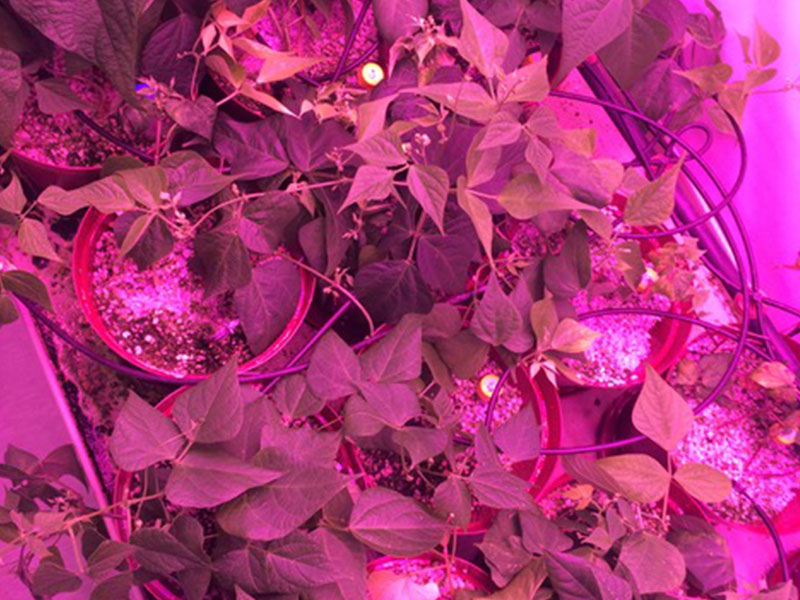
Plants cultivated in a controlled-environment growth chamber equipped with programmable LED lighting and environmental control systems to support plant physiology, crop science, and biotechnology research.
Understanding the Relationship
Air consists primarily of nitrogen and oxygen molecules moving continuously within a given space. As temperature increases, these molecules move faster and spread further apart. The air becomes less crowded at a molecular level.
This creates more space for water vapour molecules to exist between the surrounding gas molecules. As a result, warmer air can contain more water vapour before condensation occurs.
The amount of water in the air may remain unchanged while the relative humidity changes significantly.
Consider a sealed growth chamber. If the air temperature increases, no water is added to the system. Relative humidity nevertheless decreases because the air’s moisture-holding capacity has increased.
The opposite occurs when air is cooled. Relative humidity rises because the air’s moisture-holding capacity decreases. Continued cooling eventually results in condensation.
This relationship explains why temperature and humidity control are closely connected within any controlled environment.
The Influence of Biological Activity
The relationship becomes more dynamic once living organisms are introduced into the chamber.
Plants, fungi and even soil media mat release humidity to its environment. This continuously influence the conditions within the chamber.
Plants absorb water through its roots and release moisture through transpiration. Fungi exchange moisture with its surroundings as part of normal growth and metabolic activity. Growth media store and release water depending on environmental conditions.
The biological load therefore changes the environmental conditions throughout the growth cycle.
A chamber containing newly planted seedlings behaves differently from a chamber containing mature plants. The amount of moisture released into the air generally increases as biomass develops.
Environmental control systems must accommodate these changes while maintaining stable growth conditions.
The Effect of Irrigation
Automated irrigation introduces an additional environmental variable.
Every litre of water entering the chamber must ultimately go somewhere.
Some of it becomes plant biomass. Some of it remains in the growth medium. A significant portion eventually returns to the air through evaporation and transpiration.
An irrigation event may occur in the morning while humidity levels remain stable. Several hours later, humidity may begin increasing as plants respond physiologically and the growth medium releases moisture into the surrounding air.
The environmental conditions observed within the chamber therefore reflect both the irrigation timing and the biological response of the crop.
Why the User Requirement Matters
The interaction between temperature, humidity, irrigation and biology highlights an important aspect.
A researcher may initially request a chamber with a specific footprint, number of shelves or lighting arrangement. These are important considerations, but they do not define the environmental challenge.
The first question should always be: what must the facility achieve?
Will it support seed germination?
Will it grow mature plants?
Will it cultivate fungi?
Will it accommodate automated irrigation?
Will it support high-density research trials?
Each application creates a different environmental load and a different control requirement.
For this reason, LIS begins with a User Requirements Specification (URS).
The URS defines the biological objectives, environmental conditions and operational requirements of the facility. It establishes the performance criteria against which the final system will be designed and verified.
Engineering Before Manufacturing
Manufacturing is often the most visible stage of a project. It is also one of the later stages.
The engineering process begins once the requirements are understood.
The required temperature range influences heating and cooling capacity.
The required humidity range influences humidification and dehumidification capacity.
The expected biological load influences air movement and moisture management.
The irrigation strategy influences latent moisture loads within the chamber.
Local climate conditions influence equipment selection and operating capacity.
These factors interact continuously. Decisions in one area influence performance in another.
The engineering task is therefore to translate biological requirements into a practical environmental control strategy.
Only once this process is complete can manufacturing begin.
From Requirement to Verification
At LIS, growth chamber projects follow a structured sequence.
The process begins by defining the user requirement.
Engineering then determines how the required environmental conditions will be achieved.
Manufacturing produces the facility in accordance with the approved design.
Verification confirms that the completed chamber achieves the original performance objectives.
This approach ensures that the chamber is evaluated against measurable requirements rather than assumptions.
Conclusion
Temperature and humidity control form the foundation of growth chamber performance. Its interaction becomes increasingly complex once plants, fungi, growth media and irrigation systems are introduced.
Successful growth chamber projects therefore begin with a clear understanding of what the facility must achieve.
A well-developed URS provides this foundation. Engineering converts the requirement into a practical solution. Manufacturing delivers the physical facility. Verification confirms performance.
This process creates a direct link between scientific objectives and environmental control performance. The result is a growth chamber designed around the needs of the research programme rather than around a predefined piece of equipment.
